

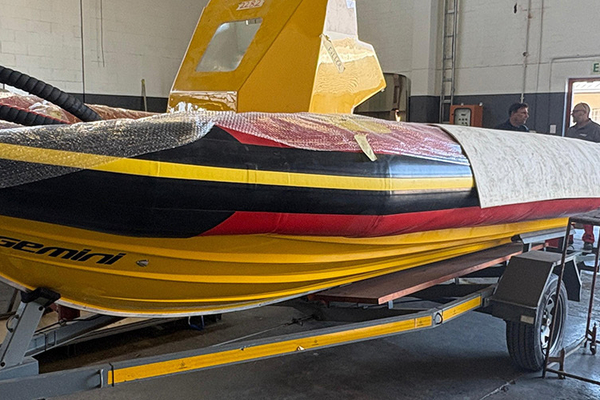
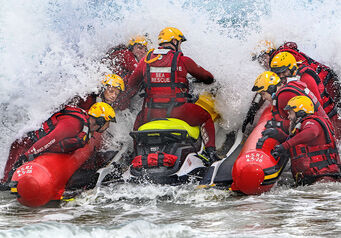
When Gemini Marine began building the first of the new 5.5-metre rigid inflatable boats (RIBs) for the NSRI, destined for Station 14 in Plettenberg Bay, it marked more than a routine fleet upgrade. It reflected a renewed focus on what works best in surf, and a recognition that, in the surf zone, a single metre in hull length can change everything.
For years, the NSRI has operated a mix of 5.5m and 6.5m RIBs, each suited to different roles. But for stations launching through shore break and working in short, punchy wave periods, the shorter boat has never lost its appeal.
Listening To the Stations
NSRI’s Head of Fleet and Facilities, Graeme Harding, says the decision was driven by operational realities rather than a shift in policy. “It’s not the decision to bring back, as we still had many in the fleet. Some stations cannot house a bigger boat, so when theirs came up for replacement, we decided to change the console setup and build a new one.”
From a training and handling perspective, the benefits of a shorter hull in surf are evident. “A shorter boat is easier to handle on the beach, very nimble in the surf, remembering that the 5.5 was originally designed for South Africa’s challenging surf,” Graeme explains. While the 6.5m RIB retains critical capabilities offshore and in other rescue roles, he acknowledges that, in most surf applications, the smaller boat has the edge.
He adds that wave timing plays a major role: “The longer a boat is, the slower it is to turn, which, when the wave period gets down to a few seconds in between waves, makes the 5.5 a lot better.”
The Backbone of Station 14
In Plett, those differences are lived daily. Station Commander Jaco Kruger describes the 5.5m RIB as central to his crew's operations. “In a lot of ways, the 5.5m RIB is the backbone of our station.”
Speed of launch is critical in emergencies. “It launches quite quickly because you only need roughly three people to run the dolly down the beach and drop it in the surf,” he says. While not the fastest vessel, it is ideally suited to drownings in progress and close-in rescues.” It’s the vessel that supports the first-responders. It’s the one that brings the defibrillator, brings the oxygen. Once the JetRIBs are on scene, this boat takes care of the rest.”
Practical constraints also play a role. Station 14’s base cannot easily accommodate a larger hull, but Jaco believes the choice would be the same even without that limitation. “It’s just a really well-balanced boat that handles incredibly well,” he says.
A Boat That Teaches and Forgives
Jaco’s confidence in the design comes from long experience. “It really teaches coxswains how to drive. It’s a convert-bracket boat that is very forgiving. It can take a big wave, and it is manoeuvrable.” For many crews, the 5.5m RIB is the perfect step between smaller craft and larger offshore rescue boats, combining stability with responsiveness.
The new boat will be familiar in shape but improved in detail. “It will be a little lighter, and the layout is also slightly different,” Jaco says, “there’s a lot of thought that’s gone into the finer details of the vessel. It’s not an overcomplicated boat.”
One Metre, Real-World Impact
Graeme sees the development as proof that the organisation adapts its fleet based on what crews experience in real rescues. “The bottom line is we are listening to stations. If they deem the 5.5 the correct boat for them, then we have to accommodate this.”
In surf rescue, the proof is in the pudding. A shorter hull turns faster between waves and launches more easily from the sand. Reintroducing the slightly modified 5.5m RIB carries a simple lesson from years of hard-won experience: sometimes, the smallest thing can make the biggest difference.
A sea rescue coxswain aboard a French warship
Read More
Western Cape Premier Alan Winde today visited the National Sea Rescue Institute (NSRI) Volunteer Support Centre (VSC) in Cape Town to thank volunteer crews and staff from across the province who were activated during the recent floods. ...
Send us your favourite photograph of NSRI people doing what we do, and you could win an NSRI shop voucher worth R250! ...
The NSRI has secured a significant three-year partnership with the Victor Daitz Foundation and World Relief Australia to fund a dedicated Drowning Prevention Instructor in Richards Bay, KwaZulu-Natal. ...