

Every year, far too many young children in South Africa drown in home swimming pools. It’s a heartbreaking reality – and one that is almost entirely preventable. Despite awareness campaigns, incidents remain alarmingly high, particularly among children under the age of five.
Caryn Formby, a leading expert in pool safety, has spent years working with disaster risk management teams and legislators to educate homeowners and improve regulations.
She often sees the same misconception: many homeowners assume responsibility shifts to tenants, visitors, or the people using the pool.
“Legally and ethically, the responsibility always rests with the property owner,” she says. “Part of our role is continually educating pool owners about these risks, reinforcing that proper safety measures are an essential part of being a responsible pool owner.”
Despite ongoing education efforts, children still gain unsupervised access to pools, and tragedies continue. Caryn explains that awareness campaigns alone are not enough.
“For meaningful change to occur, the message must also come from policymakers, municipalities, and city decision-makers who can introduce enforceable safety requirements,” she says. “We need a dual approach - sustained public education paired with legislative action.”
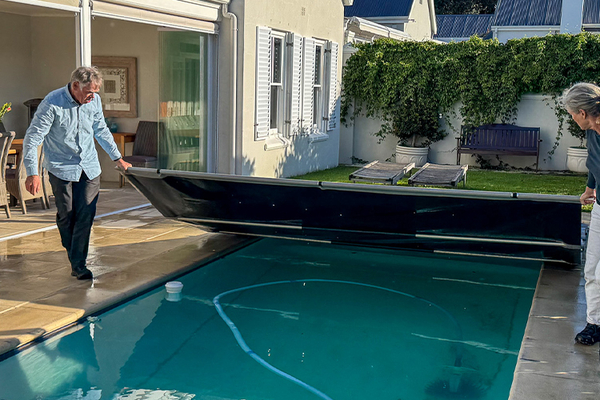
Legally, homeowners must ensure that a pool is inaccessible to unsupervised children, typically through the use of a secure fence or wall. Beyond this, the SANS 10134 guideline provides recommendations for compliant safety measures, including fences, nets, and approved safety covers.
While not yet legally enforceable, Disaster Management teams in the Western Cape have drafted a by-law ready for municipal adoption, which would give these guidelines legal force.
Caryn stresses that the best protection comes from a layered approach, combining multiple safety measures around the pool.
She outlines what an ideal setup looks like:
Physical barrier: a minimum 1.2 m fence with a self-closing, self-latching gate to prevent unsupervised access.
Certified pool safety device: a professionally installed pool safety net or solid cover.
Swimming and water-survival skills: age-appropriate swimming lessons and basic water-safety training for children.
Adult supervision: the key layer. The more children who swim, the more supervisors are needed.
“When these elements work together, they create a robust, practical, and highly effective defence against drowning,” Caryn says.
Choosing the right equipment is equally important. Caryn advises homeowners to ask:
Does the fence, net, or cover meet required child-safety standards?
Is the supplier qualified to accredit the product according to SANS 10134?
Can they provide a certificate of compliance for the installation?
She also recommends regular checks, particularly before warmer months. Nets or covers should be replaced every five years, or immediately if damaged. Fences and gates must be inspected for wear, rust, or weakened components.
Pool safety is not just a legal obligation, it is a moral responsibility. “All South African pool owners should stand together and demand that their municipality adopt the new by-law,” Caryn urges. “Pressurise your municipality to ensure all pools in their area are safe. Know CPR, talk pool safety in social gatherings, and become an anti-drowning warrior. Child drownings are entirely preventable when the right measures are taken.”
By combining proper barriers, certified devices, swimming skills, and vigilant supervision, homeowners can dramatically reduce risk and transform their pools into safe spaces for children to play and grow.
NSRI collaborates Rescue and Community Programmes for stronger impact
Read More
Western Cape Premier Alan Winde today visited the National Sea Rescue Institute (NSRI) Volunteer Support Centre (VSC) in Cape Town to thank volunteer crews and staff from across the province who were activated during the recent floods. ...
Send us your favourite photograph of NSRI people doing what we do, and you could win an NSRI shop voucher worth R250! ...

The NSRI has secured a significant three-year partnership with the Victor Daitz Foundation and World Relief Australia to fund a dedicated Drowning Prevention Instructor in Richards Bay, KwaZulu-Natal. ...