

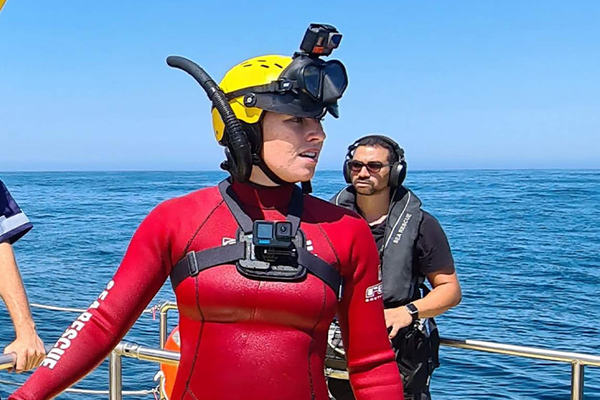
At just 22 years old, Roxy Traylor has already led a life shaped by the ocean although, as she admits, it wasn’t love at first sight.
“Funny enough, I didn’t always love the ocean,” she says. “I had some bad experiences when I was younger and trying to use a Malibu board (a kind of surfboard used by lifeguards), and I always struggled to feel comfortable in the ocean.”
Growing up a competitive swimmer, Roxy’s confidence in the water was clear, but it took a Robben Island swim to transform her relationship with the sea. “Paula Armstrong, who is a phenomenal open water swimmer, organised a Robben Island crossing to raise funds for NSRI’s drowning prevention work. That swim was really where I made my peace with the ocean. The hours of training boosted my confidence and my love for it.”
Those training hours eventually led Roxy from a nervous swimmer to an NSRI rescue swimmer, and now, to coxswain at Station 3, Table Bay.
For Roxy, confidence and respect go hand in hand. “There’s a plaque in our station that says you should always fear the ocean, because when you stop fearing the ocean, that’s when you lose to it. I often take a moment to read it when I arrive at the base. The ocean demands respect.”
From lockdown to lifeboats
Roxy’s NSRI journey began when she was still in matric, at a time when the world had slowed down. “In 2020, during lockdown, all the sports I was doing stopped,” she recalls. “It first seemed like a fun little holiday, but I really struggled to motivate myself. One day, my mom and I read the NSRI magazine together, and she suggested I see if I could join.”
The timing was perfect. “I’m not exaggerating when I say joining NSRI kept me sane,” she says. “Having NSRI meant that a few days a week, I wasn’t treated like a school kid, but like a fully capable adult. It took away a lot of the stress of matric, and I’m so incredibly glad I joined.”
Rising through the ranks
Learning the ropes of sea rescue is no small feat. From knot-tying to navigation, every skill has to be mastered before taking the helm. “As a trainee, I was exposed to so many new things,” Roxy says. “Every new thing I learnt made me realise how much I wanted to be there.”
Becoming a coxswain was the next step, one that required not just skill but trust. “It did take quite a bit of persuasion for me to start training to be a coxswain, but once I started, I could feel how supportive everyone was.”
Leadership, she says, is something she’s comfortable with, even when the responsibility feels immense. “As coxswain, you’re responsible not just for the casualties, but also for your crew. At 22, I’m the youngest at our station, but it’s never been a question of age; it’s about experience and commitment.”
A test in the wind
That commitment was put to the test on 6 December, when two stand-up paddle boarders were being swept out to sea in strong south-easterly winds near Bakoven. It was Roxy’s first rescue in full command of a rescue vessel.
“We had just come back from training when the call came through,” she remembers. “We knew what the conditions were like – windy, bumpy, but manageable.”
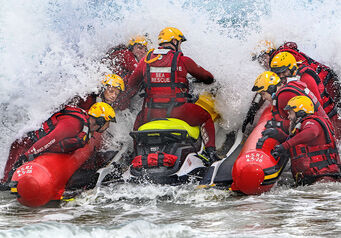
Within minutes, Roxy and her crew were powering through 30-knot gusts on the Spirit of Day, the 6.5 meter Table Bay rescue boat. The sea spray was relentless, visibility was low, and the stakes were high. “When the wind chop is that large, it’s very difficult to see casualties who are not much higher than the surface,” she explains. “The urgency was ramped up. We had to get there quickly.”
On arrival, they found the two paddlers a nautical mile offshore. “It wasn’t an overly technical rescue,” she says, “but what stuck with me was how relieved they were. There’s a moment where you could see the fear they had that there was no rescue coming.”
As the rescue boat returned to shore, Roxy was greeted with cheers from her fellow crew members. “It felt pretty powerful to have people encouraging me from the slipway as we were about to launch,” she says. “That will always stay with me.”
Respect, teamwork and growth
Reflecting on her early months as a coxswain, Roxy speaks about teamwork and humility. “As a coxswain, it’s your responsibility to train the future crew and coxswains, and as we’re always told, train them to be better than you,” she says. “Allowing people to make mistakes in training, and helping them understand why, builds confidence and skill.”
Looking ahead, her focus is steady. “I want to make a difference within the organisation by training new crew and coxswains. The goal of the NSRI is to save lives, and one of the ways I can contribute is by making sure the people responding are equipped with all the skills they need.”
For Roxy, the sea that once felt intimidating has now become her purpose. A place of challenge, respect, and quiet courage. As she puts it, “For as long as I can, I’ll be part of NSRI, improving myself, and the crew around me so that we can save lives.”
NSRI Launches National Fundraiser After One of Its Busiest Rescue Periods
Read More
Western Cape Premier Alan Winde today visited the National Sea Rescue Institute (NSRI) Volunteer Support Centre (VSC) in Cape Town to thank volunteer crews and staff from across the province who were activated during the recent floods. ...
Send us your favourite photograph of NSRI people doing what we do, and you could win an NSRI shop voucher worth R250! ...

The NSRI has secured a significant three-year partnership with the Victor Daitz Foundation and World Relief Australia to fund a dedicated Drowning Prevention Instructor in Richards Bay, KwaZulu-Natal. ...