

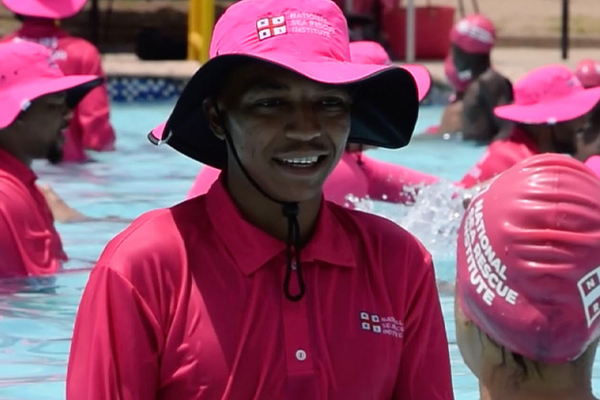
The NSRI’s AQUA Survival Swimming Programme in Wellington is transforming a community’s relationship with water by training municipal lifeguards as survival swimming instructors and equipping local children with the skills to save themselves.
Rooted in painful memories of local drownings and driven by a strong partnership among the NSRI, Drakenstein Municipality, and the Community Development Workers Programme, it is both deeply personal and quietly pioneering. For Community Development Worker Edwina Samuels, the launch at Pentz Street Swimming Pool is the fulfilment of a long-held dream that began with tragedy. As a child, she watched a neighbour’s son drown in this very pool, an experience that stayed with her each summer as she saw children flock to the water, often without adult supervision. When she started working in the Drakenstein area, she was determined to protect children from similar loss, and the idea of a structured survival swimming initiative became her guiding vision.
That vision found its vehicle in the NSRI’s Survival Swimming Programme, which focuses on teaching children simple skills to stay afloat and reach safety rather than traditional stroke-based swimming.
For Edwina, survival swimming means that children will know exactly what to do if they get into difficulty in a pool or at the sea, and even how to recognise when a friend is in trouble and call for help. Although she cannot swim herself, due to fears passed down from older generations, watching the lessons has inspired her to learn alongside her daughter and break that cycle.
The programme in Wellington began when the Community Development Workers Programme approached NSRI Regional Coordinator Caville Abrahams to explore a survival swimming project in Drakenstein. At that time, there were no qualified survival swimming instructors in the region, but a simple suggestion changed everything: why not train the municipal lifeguards?
Drakenstein Municipality immediately backed the idea, offering both its lifeguards and its public pools. Nine lifeguards completed instructor training over two days, completing their practical assessment on 27 November.
Caville explains that survival swimming centres on four basic skills: breath control, orientation, floating and moving through the water just far enough to reach safety. In Wellington, the need is stark. The town is surrounded by dams where children have drowned, and even the Pentz Street pool has a history of a fatal incident a few years ago.
For Caville, using lifeguards as instructors is both practical and visionary: it deepens their engagement with the public, provides them with new skills, and creates a pathway for today’s learners to become tomorrow’s club swimmers, lifeguards, and even members of water-based professions.
For Drakenstein, this project is also a statement about what kind of municipality it wants to be. Mayoral Committee Member for Sports, Recreation, Tourism and Environment, Laurichia van Niekerk, describes a long-standing partnership with the NSRI that began with lifeguard training and has grown into a broader community safety campaign.
Wellington’s extreme summer heat, with temperatures regularly exceeding 40 degrees, means local pools and rivers are magnets for children and families, making water safety an essential part of the municipality’s festive season planning.
Laurichia points to a tragedy in 2023, when a 13-year-old child drowned at Pentz Street, as a turning point that sharpened the focus on teaching water skills from early primary school age. She notes that Drakenstein is believed to be the first municipality in the country to use its own lifeguards as survival swimming instructors, a move she hopes others will follow. Her message to municipalities is clear: invest in programmes like this to build safer communities, safer holidays and safer futures for children, and do not hesitate to invite the NSRI to become a partner.
On the pool deck, the impact of this innovation is visible in the pride of the lifeguards themselves. For Wellington lifeguard Marche-Lee Stephens, who has worked at municipal pools for eight years, teaching survival swimming feels like a privilege because it allows children who visit beaches, rivers and dams to return home safely. The new training has given her a more detailed, step-by-step approach, and she describes the moment a child finally manages to float independently as both exciting and deeply satisfying.
Her colleague, lifeguard Breyton Festus, is in his fifth summer season and had never formally taught children before the NSRI introduced the programme. He describes the experience of teaching children how to prevent drowning in their community as amazing and a way of giving back, especially since many young people do not have access to private pools and rely on public facilities. Working patiently with children who struggle at first, he is already looking ahead to involving more schools and bringing more learners into the programme.
For the learners, the new skills are as emotional as they are practical. Newton Primary Grade 7 learner Anlique Louw says that, for the first time, she learned to open her eyes underwater, enjoy the movement of the water and float confidently on her back. Her classmate, Marshey Vika, highlights floating as the best part of the day and proudly explains how she learned to put her legs in the water and kick, something she couldn't do before.
Both girls say they would love to return for more lessons, a simple but powerful sign that the programme is doing more than teaching lifesaving technique; it is building lasting confidence around water.
For Edwina, Caville, Laurichia and the lifeguards, this is exactly the point. Each new back float mastered at Pentz Street is one more child who will not panic if they suddenly find themselves out of their depth, and one more family with a better chance of avoiding the heartbreak that first inspired this initiative.
The decisions behind every NSRI rescue
Read More
Western Cape Premier Alan Winde today visited the National Sea Rescue Institute (NSRI) Volunteer Support Centre (VSC) in Cape Town to thank volunteer crews and staff from across the province who were activated during the recent floods. ...
Send us your favourite photograph of NSRI people doing what we do, and you could win an NSRI shop voucher worth R250! ...

The NSRI has secured a significant three-year partnership with the Victor Daitz Foundation and World Relief Australia to fund a dedicated Drowning Prevention Instructor in Richards Bay, KwaZulu-Natal. ...