


For anyone who has spent time on South Africa’s coastline, it’s easy to imagine: a rescue boat heading out in rough seas, responding to a call for help and suddenly, no communication with shore. For the NSRI, that’s not a hypothetical. Traditional radio and cellular networks often fail in some of the country’s most remote and rugged areas, like the Wild Coast or stretches near Richards Bay.
“Communication is everything in a rescue,” explains Charl Maritz, NSRI’s Operations Manager. “If crews can’t talk to shore, they lose vital support, updates, and coordination. It slows down rescues and increases risk for everyone involved.”
The problem isn’t just distance. South Africa’s dramatic coastline – cliffs, gorges, and isolated bays – often blocks line-of-sight radio signals. Add in storms, fog, or high swells, and connections become even less reliable. On long missions, boats can slip entirely out of range, leaving crews without updates from base or the ability to request backup.
Historically, one solution has been to use another vessel or shore-based mobile (vehicle) as a “relay station,” essentially a middleman passing along messages. But that’s not always possible, and it eats up precious time during emergencies.
That’s why, over the past six months, the NSRI has been testing equipment from GlobalCom, including Iridium Icom satellite PTT (Push to Talk) radios. These radios connect directly to satellites rather than relying on towers or repeaters on land.
The systems promise “anytime, anywhere” coverage, giving crews a direct line to shore, to other vessels, and to the NSRI’s Emergency Operations Centre. This is on the proviso that the “receiving” station has similar equipment, correctly set up.
Deon Langenhoven, who led the testing, recalls being struck by the system's simplicity: “We can, with a click of a button, expand the reception area to where we need it.”
With this type of equipment, the results are clear: crews can maintain steady communication, whereas before, there had been silence. In Kommetjie, for example, new GSM-based radios also proved effective for inshore stations, filling smaller coverage gaps within the cellular network.
Satellite systems don’t just provide clearer conversations. They enable data transmission, including GPS tracking, weather updates, and even the potential for live video feeds. For shore-based coordinators, this means knowing exactly where boats are at any given time, and for crews, it means receiving critical updates in real time.
“Reliable satellite comms improve safety,” Charl says. “They make rescues faster, more coordinated, and give crews confidence knowing they’re never out of touch.”
Right now, cost remains a hurdle. Satellite radios are still expensive, so the NSRI is prioritising stations with the greatest need. But as Deon points out, safety comes first. “If our crews and vessels cannot communicate with anyone, it puts them at great risk.”
There’s also optimism about the future. Technologies like Starlink, with its constellation of Low-Earth Orbit satellites, promise to bring high-speed, affordable connectivity to previously unreachable areas. For the NSRI, that could mean not only better rescues but also remote training, digital mapping, and even extending communication to underserved coastal communities.
Until then, the trials continue. For NSRI crews venturing out into rough seas, knowing they can call for help, or check in with base, marks a quiet but vital step forward in saving lives.
Meet Paul Bevis: a life shaped by Sea Rescue
Read More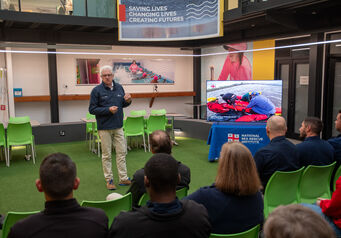
Western Cape Premier Alan Winde today visited the National Sea Rescue Institute (NSRI) Volunteer Support Centre (VSC) in Cape Town to thank volunteer crews and staff from across the province who were activated during the recent floods. ...
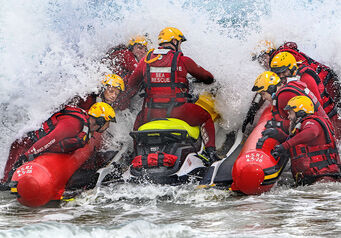
Send us your favourite photograph of NSRI people doing what we do, and you could win an NSRI shop voucher worth R250! ...
The NSRI has secured a significant three-year partnership with the Victor Daitz Foundation and World Relief Australia to fund a dedicated Drowning Prevention Instructor in Richards Bay, KwaZulu-Natal. ...