


A concerned call from a member of the public led to the disentanglement of a juvenile humpback whale.
The avid whale watcher contacted the NSRI after spotting a whale in distress near Miller’s Point. Upon further investigation, the whale was found wrapped in fishing ropes and appeared to be anchored to the sea bed.
According to the World Wide Fund for Nature (WWF) South Africa, one of the biggest threats to whales and dolphins is accidental capture in fishing gear. Their website states that whales can drown from the exhaustion of dragging fishing lines, or from not being able to breach the surface for air. The whale could also starve to death if it’s unable to move for a longer period of time.
No doubt with this in mind, South African Whale Disentanglement Network (SAWDN) volunteers and NSRI Simonstown crew quickly sprang into action. Two NSRI Simonstown rescue craft were launched, Donna Nicholas and Jack&Irene, carrying the SAWDN’s specialised cutting equipment.
The NSRI’s partnership with SAWDN has resulted in 140 volunteers (from 18 stations) being trained to perform highly intricate disentanglement operations. Volunteer crew respond to around 15 call-outs per year to assist whales.
Whale disentanglement operations are a costly exercise – the WWF estimates that fuel costs alone can amount to R4 500 per operation. With an average of 15 occurring per year for the past five years, that equates to about R67 500 annually.
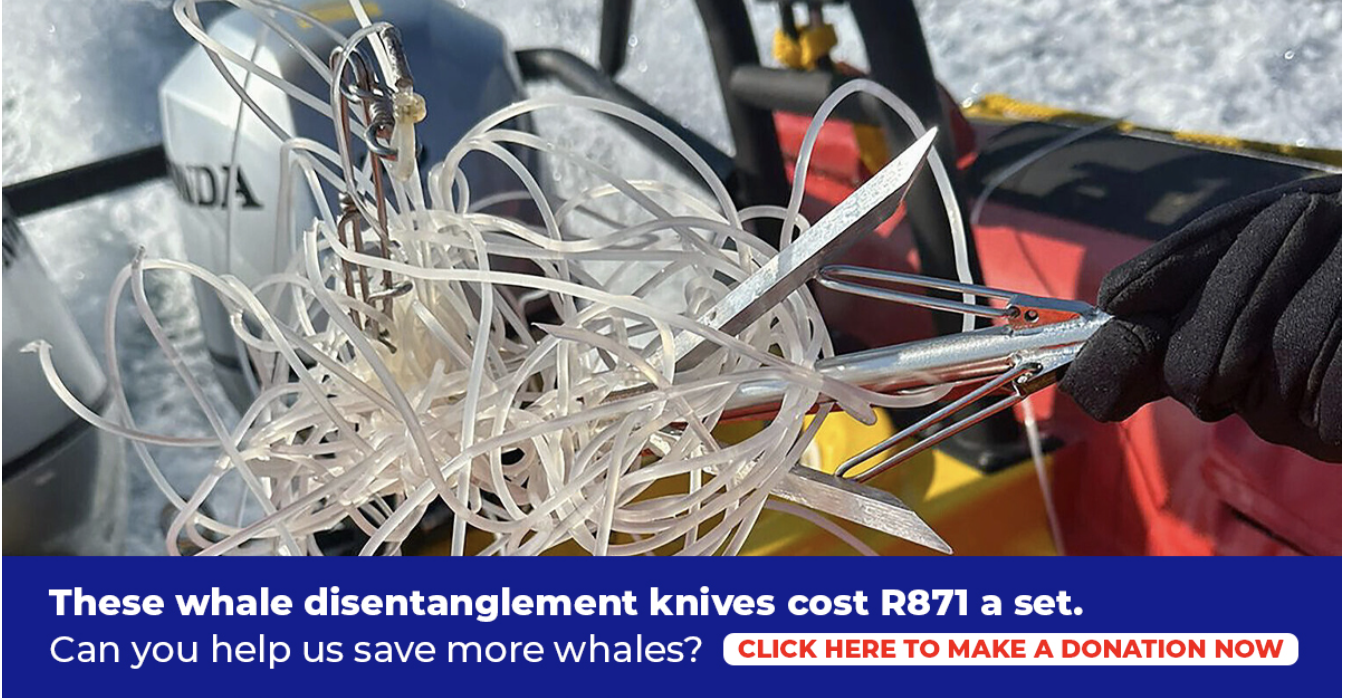
On arrival at the scene, in choppy sea conditions, blustery winds and rain, the SAWDN crew started cutting rope from the whale. It was found that four wraps of fishing rope were around its tail and one around its body.
A few whales, including a larger whale who appeared to be the juvenile’s mom, remained close by while the crew worked to remove the ropes. The operation was more difficult than expected, as the stricken whale was showing signs of distress and the crew was battling rough sea conditions.
The local fishing boat Iingwane, carrying members of the SAWDN, responded from Kalk Bay harbour to assist. The Iingwane's crew lifted the fishing line that was anchored to the sea bed, making it easier to reach the wraps of rope around the whale’s tail using the SAWDN pole and cutting knife.
Three further cuts of the fishing rope were made, it finally unravelled, and the whale was able to swim freely. All ropes were recovered onto the fishing boat.
In what appeared to be a show of gratitude, the whale stayed near his rescuers for a while, before rejoining its mom and disappearing into the distance.
If you see a whale in distress, please call the NSRI’s Emergency Operations Centre on 087 094 9774.
The NSRI Lifeguarding Unit: We are ready!
Read More
Western Cape Premier Alan Winde today visited the National Sea Rescue Institute (NSRI) Volunteer Support Centre (VSC) in Cape Town to thank volunteer crews and staff from across the province who were activated during the recent floods. ...
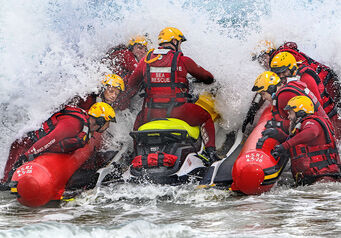
Send us your favourite photograph of NSRI people doing what we do, and you could win an NSRI shop voucher worth R250! ...
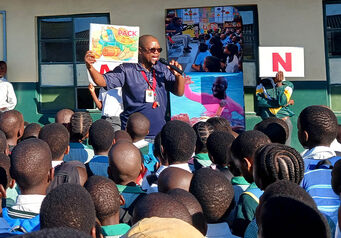
The NSRI has secured a significant three-year partnership with the Victor Daitz Foundation and World Relief Australia to fund a dedicated Drowning Prevention Instructor in Richards Bay, KwaZulu-Natal. ...