

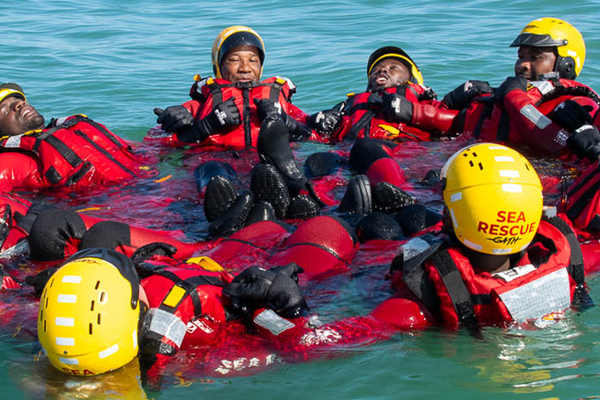
At the start of September, ten aspiring coxswains packed their gear and set off on a two-week journey that would take them the length of South Africa’s coastline. From Melkbosstrand to Mdumbi, the country’s newest Class 4 Coxswain course unfolded not in a classroom, but on the water itself.
Led by NSRI Training Officer Simphiwe Rorwana, Head of Fleet and Facilities Graeme Harding, and Chief Operations Officer Brett Ayres, the course was the first of its kind: a 14-day, coast-to-coast training expedition designed to fast-track participants toward their Class 4 qualification through hands-on learning in real conditions. Along the way, the team trained at several stations, including Kleinmond, Oyster Bay, Storms River, East London Witsand, and Wilderness, absorbing the collective experience of NSRI’s crews.
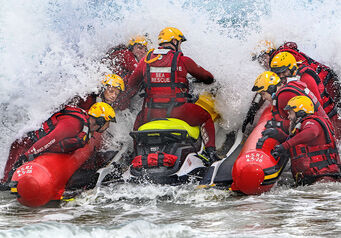
At Station 23 Wilderness, where the surf is legendary, the course found some of its most testing conditions. For Jonathan Britton, who hosted that leg of the journey, it was about more than big waves.
“Wilderness is well known for its big surf,” he said, “but what makes Wilderness unique is less about the waves themselves and more about the culture and legacy that have grown here over decades.”
That culture, Jonathan explained, traces its roots back to four handwritten notes by Regional Representative, Hennie Niehaus – then a Class 3 Coxswain and Deputy Station Commander – that became the foundation for the station’s first surf course in 1996. “Those notes sparked a culture of reflection and continuous improvement that has shaped the skills, leadership, and ethos of Station 23’s coxswains and crews ever since.”
During the course, candidates were put through their paces, always under careful supervision. And “their learning extended beyond technical helming skills,” Jonathan said.
“We connected this to our readiness systems for responding to drowning-in-progress scenarios. For our crew, it was a privilege to showcase our operations while also receiving constructive peer feedback. That kind of informal ‘sense-check’ is invaluable.”
One of those candidates was Thulani Gxala from Station 49, Mdumbi, who described the experience as transformative. “From day one at Melkbosstrand, I learned a lot,” he said. “They are so committed and love what they do, and that made me feel comfortable being out there on the boat.”
By the time the group reached Wilderness, Thulani’s confidence had grown. “Launching at Kleinmond and Wilderness was not as easy as other sites,” he recalled. “One of the Wilderness crew asked me at the backline, ‘Are you already a coxswain?’ I said no, and he said, ‘You ride it as if you’re already one.’ That put my confidence on another level.”
The mobile format also impressed Jonathan and his team. “What stood out most was how well-prepared the coxswains were on arrival,” he said. “They came to us as a cohesive unit. Communication with the VSC training leadership was excellent, and their trust in us was humbling.”
When a real call-out occurred mid-training, the exercise instantly shifted into an operational rescue, proof of how seamlessly training and readiness intersect at NSRI. “It was a timely reminder of why we train the way we do,” Jonathan said.
For Nkazimulo Nyawose, another participant, the variety of conditions was invaluable. “It was an incredible experience. Exhausting but incredible,” he said. “Each environment had its own hazards, like rocks, rip currents, and sandbanks. One thing I took out from going place to place is that you are always learning the sea because the conditions are ever changing, never make yourself an expert.”
Reflecting on the two weeks, he added, “Being a coxswain is about many things, but one thing I took away is that you have to know your crew. If you take time and get to know each other, you’ll be surprised by what you can achieve as a team.”
Jonathan believes this interstation model has great promise. “It strengthens peer learning and raises standards by building a powerful learning network across the country,” he said. “By sharing not only technical skills but also operational leadership and base management practices, we enrich one another’s stations while staying true to the volunteer spirit at the heart of NSRI.”
As the course concluded at Mdumbi, the sense of accomplishment was tangible. Thulani summed it up simply: “Everything I learned, I will pass to my trainees. Now I am well prepared to make sure my community will be 100% safe. I appreciate what NSRI has done for us — thank you so, so much.”
NSRI embarks on a landmark partnership with Club Med
Read More
Western Cape Premier Alan Winde today visited the National Sea Rescue Institute (NSRI) Volunteer Support Centre (VSC) in Cape Town to thank volunteer crews and staff from across the province who were activated during the recent floods. ...
Send us your favourite photograph of NSRI people doing what we do, and you could win an NSRI shop voucher worth R250! ...
The NSRI has secured a significant three-year partnership with the Victor Daitz Foundation and World Relief Australia to fund a dedicated Drowning Prevention Instructor in Richards Bay, KwaZulu-Natal. ...