

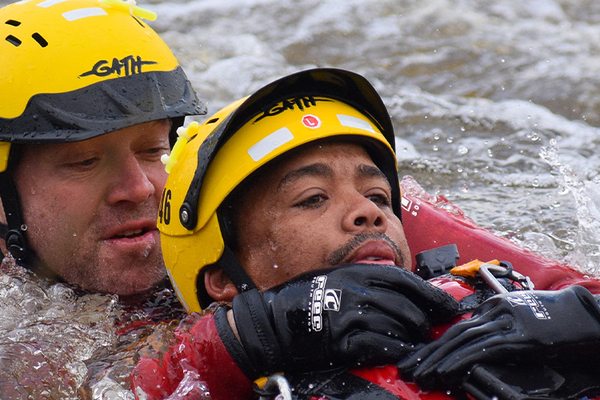
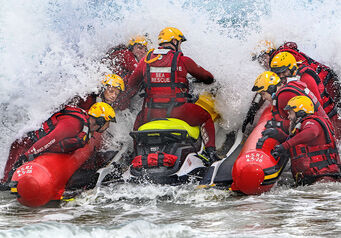
The NSRI recently hosted a Swift Water Training weekend, led by Training Officer Dean Wegerle. The course, regarded as one of the most challenging on the NSRI training calendar, brought together volunteers for an intensive three-day programme at the Breede River.
“Swift water training is one of the most dangerous courses we run at the Institute. It's one of two — the other is Maritime Extrication training. We spend a lot of time putting extensive safety measures in place, and reinforcing with the students the importance of layers of safety ,” explained Wegerle.
Unlike the sea, where tides ebb and flow, swift water provides unrelenting pressure and constant force. “Moving to the swift water realm is a very different environment, and it is quite tricky for the crew because it just keeps coming, and the pressure is constant, and it's always there.”
The training is designed to instill respect for this powerful environment while equipping crew members with the knowledge and skills needed for safe operations. “The outcome of the course is to ensure that they are versed in all the dangers and situations, how to read the river, what hydrology is, how to see what's going on underneath the water surface, and how to identify dangers before going in,” Wegerle added. “Part of the training is called TRETHROG, which is talk, reach, throw, row, and then go.”
We went to our standard training spot on the Breeder River, and conditions were ideal. “When we say that conditions are good, we mean it's good for training. When there's not a lot of water flow, you can't do effective training. And at the end of the day, you want the crew to understand the danger of getting into swift water because you need to have enormous respect for it,” said Wegerle.
Training Officer Danie Verwey noted two things that stood out over the weekend: “Realising the dangers of working on and in a river, and the camaraderie of all the stations working together to achieve one objective.”
For many participants, the experience was eye-opening. Stéfan Grové of Station 31, Stilbaai, said: “The main thing that I took away from this is that there's a saying that goes, 'Prepare for the worst and hope for the best'. And with swift water, that really is true.”
Edrich Kotze, Hermanus Station Commander, reflected: “Although the weekend was physically and mentally challenging, there was a lot to gain. The course highlighted the dangers of working under swift water conditions and how to approach them with knowledge, skill, and competence.”
For Durban Crewman and Drowning Prevention Coordinator for KZN, Siyabonga Mthethwa, the training weekend “was an invaluable opportunity for me and our crew to strengthen both our technical skills and teamwork.” He added, “I was left feeling energised, confident, and ready to make proactive, life-saving decisions when it matters most.”
NSRI Training Manager, Bruce Sandmann, said the weekend brought a wide range of conditions. Despite no local rainfall, the river rose by half a metre, and crews spent the entire Saturday training in the water. A night-time exercise added to the challenge, with winds of up to 35 knots sweeping through the valley. Bruce said the scenario provided real-life conditions that tested the crew, who performed exceptionally well.
The weekend concluded with weary but inspired crew members returning to their stations with strengthened skills, stronger camaraderie, and a renewed respect for the immense power of moving water. As Wegerle summarised: “Overall, the course was great. We achieved our objectives, and everyone enjoyed their time, and then came back with a good respect for the water and learned a lot.”
Photo of the month: August 2025
Read More
Western Cape Premier Alan Winde today visited the National Sea Rescue Institute (NSRI) Volunteer Support Centre (VSC) in Cape Town to thank volunteer crews and staff from across the province who were activated during the recent floods. ...
Send us your favourite photograph of NSRI people doing what we do, and you could win an NSRI shop voucher worth R250! ...

The NSRI has secured a significant three-year partnership with the Victor Daitz Foundation and World Relief Australia to fund a dedicated Drowning Prevention Instructor in Richards Bay, KwaZulu-Natal. ...