

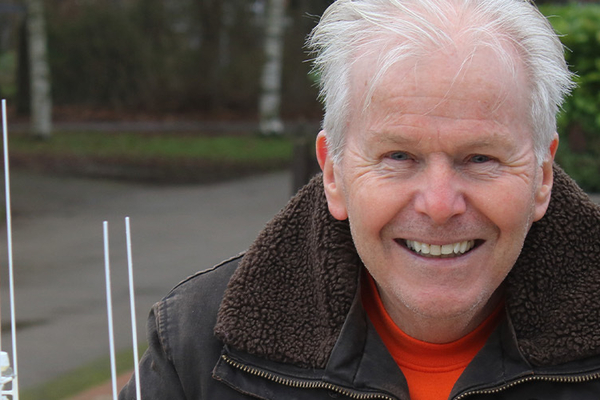
When British model builder Douglas Twine began his first-ever model lifeboat, he never imagined his project would lead him into the history and heart of South Africa’s NSRI. His working-scale model of the Brede class lifeboat is more than a technical accomplishment. It’s a heartfelt tribute to maritime rescue, connecting two nations bound by a shared lifesaving ethos.
Farewell to a Legend
Later this year, the real Brede-class lifeboat Nadine Gordimer will retire from service at Station 8, Hout Bay. In her place, the new Offshore Rescue Craft (ORC) Spirit of Ubuntu will proudly take to the water – the eighth and final vessel in the NSRI’s current new-build programme.
Her retirement stirs strong emotion. Donated in the 1980s, Nadine Gordimer has stood as a symbol of dedication and community spirit for nearly four decades. As the last Brede bows out, a small but precise echo of her legacy has taken shape over 9 000 kilometres away in Derbyshire, England.
Building the Brede in Miniature
Doug has long been a supporter of the NSRI and an avid reader of NSRI Magazine. His interest is rooted in a fascination with boats, which naturally led to a keen curiosity about South African rescue boats. That curiosity deepened after he saw photographs of the NSRI fleet and wanted to understand the vessels in greater detail. He started searching for technical references and reached out online, and the response was immediate. “Brett Ayres, along with Brad Geyser, supplied me with an amazing amount of PDF files and colour references, which helped immensely, and it all developed from then.”
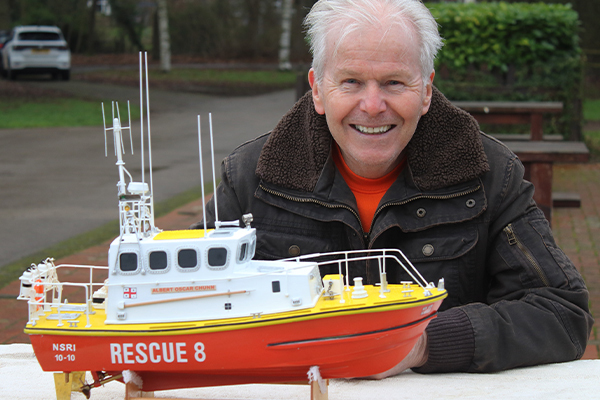
He began with a 1/20-scale kit from Mount Fleet Models, initially designed for radio control. “I acquired it with most of the parts included, but I had to scratch-build the missing components, mainly the cabin area.”
What followed was a meticulous four-month build. From the twin propellers to the handrails and coiled ropes, Douglas improvised, adjusted, and engineered every detail to achieve authenticity. Fitting the running gear alone – “two motors along with associated control components driving twin propellers” – proved a challenge, but as any radio-control enthusiast will tell you, that’s part of the satisfaction.
The Challenges of Miniature Engineering
Any model builder will agree that scaling down a lifeboat is no small task. For Doug, the space constraints inside the hull presented one of the toughest engineering puzzles. Squeezing in motors, electrics, prop shafts, and steering gear while keeping the model balanced and watertight required careful planning and a touch of trial and error.
“There wasn’t a lot of space in there,” he admits. Every centimetre mattered, especially because he wanted the model to be fully functional. The radio-controlled design allows him to sail the boat around his local Derby Model Boat Club lake, testing its agility and performance. Remarkably, this 1/20 scale Brede can turn almost within its own length.
Unlike the real Nadine Gordimer, powered by diesel engines and built to withstand fierce Atlantic swells, Doug’s version runs on quiet electric motors. But that’s almost the only visible difference. The proportions, deck fittings, and livery have all been recreated with impressive accuracy.
A Personal Connection
Doug christened his model Albert Oscar Chunn, after his maternal grandfather, a man he remembers fondly. “I have a thing about naming my models by applying some poetic license, as in this case,” he says, “plus long names seem to be applicable to lifeboats.”
It’s a touching nod to family, maritime tradition, and remembrance. Doug’s mother, who passed away last year at the age of 105, supported the Royal National Lifeboat Institution (RNLI) and is commemorated on RNLI Exmouth’s Memory Lifeboat. “My time at sea was made safer in the knowledge that organisations such as the NSRI and RNLI were there if required,” Doug reflects. “I would like to think this build will preserve a piece of history for the NSRI.”
Recognition and New Horizons
Doug’s craftsmanship hasn’t gone unnoticed. His Brede model recently featured in the February issue of Model Boats magazine in the UK, drawing admiration from fellow builders. “Rivet counters,” as the perfectionists are affectionately known, might search for faults, but Doug notes that his model’s purpose was never just about accuracy, but preservation.
Now, as Nadine Gordimer nears her final voyage, Doug’s model stands as a floating tribute to NSRI’s courage and continuity. And the story doesn’t end here: he is collaborating with Jacques Kruger, an NSRI volunteer and 3D printing specialist in South Africa, on an ORC model, based at Station 19, Richards Bay. Together, they’re sharing ideas to capture the next generation of NSRI vessels in miniature form.
A Legacy That Floats On
For Doug, sailing his model across a quiet English boating lake is both a pastime and a homage. It’s a scene far removed from Hout Bay’s rocky seas, yet somehow deeply connected. For now, though, that moment is on pause while he recovers from a recent surgery. “I’ll be on crutches for a while yet and more annoyingly a few weeks before I can make the boating lake, so in the meantime, Rescue 8 remains on her stand.”
Even at rest, his creation carries its purpose. In a small but meaningful way, it ensures that the spirit of Nadine Gordimer and all Brede-class lifeboats continue to sail steady, faithful, and unsinkable.
NSRI Mossel Bay assists boat
Read More
Western Cape Premier Alan Winde today visited the National Sea Rescue Institute (NSRI) Volunteer Support Centre (VSC) in Cape Town to thank volunteer crews and staff from across the province who were activated during the recent floods. ...
Send us your favourite photograph of NSRI people doing what we do, and you could win an NSRI shop voucher worth R250! ...
The NSRI has secured a significant three-year partnership with the Victor Daitz Foundation and World Relief Australia to fund a dedicated Drowning Prevention Instructor in Richards Bay, KwaZulu-Natal. ...