

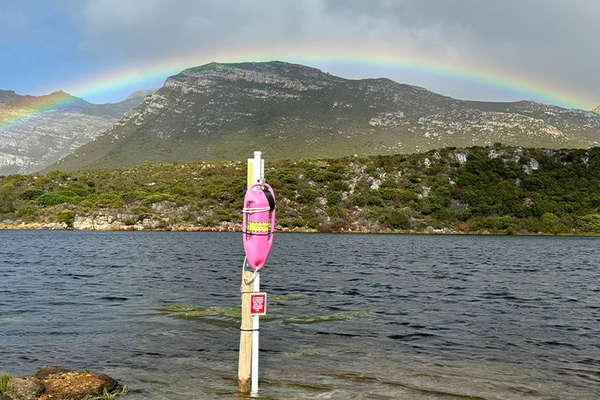
The NSRI has reached a significant milestone in its long-standing commitment to drowning prevention. By joining an international Public Rescue Equipment (PRE) working group, the NSRI is now part of a global effort to establish shared standards for life-saving equipment used by the public.
This moment marks the culmination of years of dedication. When the Pink Rescue Buoy initiative was launched in 2017, only a handful of similar programmes existed worldwide. Today, the pink buoys are not only widely recognised across South Africa but are also considered among the leading examples of public rescue equipment globally.
From Local Idea to Global Vision
The formation of the international PRE working group represents a turning point in how water safety is approached worldwide.
Adam Wooler, one of the key drivers behind the initiative, a Beach Safety Consultant and a member of the International Life Saving Federation (ILS) Drowning Prevention Commission, explains how the idea evolved:
“The original vision was actually quite focused at first. Erik Bech from the Danish Water Safety Council approached me looking for help to produce guidance on Public Rescue Equipment for Denmark because I had been involved in the development of the RNLI and SLSNZ guidance in the past. But through those early discussions, it quickly became clear that this wasn’t just a Danish issue.”
What began as a country-specific project quickly expanded into a global ambition – to create practical, evidence-based guidelines that could help save lives anywhere in the world.
The group driving this effort is made up of leaders from seven pioneering national programmes:
Building a Global Movement
Over time, PRE has transformed from isolated national efforts into a coordinated international movement. Early work by organisations like the Royal National Lifeboat Institution helped establish the importance of risk-based planning and proper guidance.
As more countries introduced their own programmes – including Ireland, Hawaii, South Africa, and New Zealand – knowledge and experience began to accumulate. Research further strengthened the case for PRE, offering insights into how bystanders can perform rescues more safely and effectively.
“We now know much more about what helps a bystander perform a rescue more safely, what equipment is easier to use, and how PRE fits into the broader drowning prevention picture,” Adam says.
Why Global Standards Matter
A central goal of the working group is to develop global standards for PRE under the auspices of the International Life Saving Federation (ILS) and, eventually, to see a global standard recognised by ISO, the International Organisation for Standardisation.
“Although coastlines differ, people don’t change that much. In an emergency, bystanders need something simple, recognisable, accessible and easy to use,” Adam explains.
Without shared standards, differences in equipment, signage, or placement could create confusion during emergencies. Establishing a common baseline ensures that PRE is intuitive and reliable, no matter where it is encountered.
Collaboration Across Borders
Bringing together organisations from different parts of the world has created a powerful exchange of ideas and expertise.
“In practice, it works because we are all trying to solve the same fundamental problem,” Adam says. “Each organisation brings its own experience, research, operational learning and cultural context to the table.”
Despite differences in environment and approach, a shared understanding is emerging around what makes PRE effective: it must be visible, easy to use, well-maintained, and supported by clear messaging.
South Africa’s Unique Contribution
The NSRI’s experience has played a key role in shaping the group’s direction by building a highly visible, community-driven safety initiative.
“What NSRI has done so well is not just deploy equipment but build awareness around it,” Adam notes. “A rescue device only helps if people notice it, understand it, trust it, and are prepared to use it in an emergency.”
The Pink Rescue Buoys, in particular, have added a new dimension to the global conversation.
“They showed that PRE can become a public symbol as well as a rescue tool,” Adam says.
Looking Ahead
The creation of the international PRE working group signals a new chapter for global water safety. It provides a platform to consolidate knowledge, develop stronger guidance, and support countries that have yet to implement PRE programmes.
Ultimately, the goal is to make rescue equipment more accessible, more effective, and more widely understood, giving people in distress a better chance of survival.
For the NSRI, this moment is both a recognition of past efforts and a step toward an even greater impact on a global scale.
Celebrate a Life with Rescue 4
Read More
Western Cape Premier Alan Winde today visited the National Sea Rescue Institute (NSRI) Volunteer Support Centre (VSC) in Cape Town to thank volunteer crews and staff from across the province who were activated during the recent floods. ...
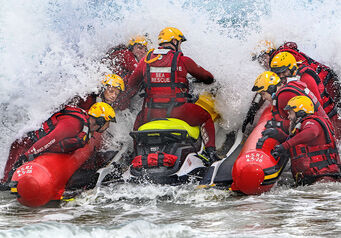
Send us your favourite photograph of NSRI people doing what we do, and you could win an NSRI shop voucher worth R250! ...
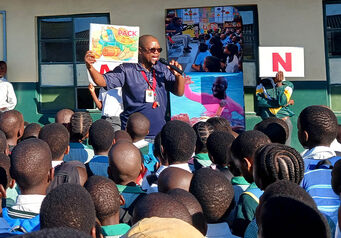
The NSRI has secured a significant three-year partnership with the Victor Daitz Foundation and World Relief Australia to fund a dedicated Drowning Prevention Instructor in Richards Bay, KwaZulu-Natal. ...