


When seconds matter, distance makes all the difference. That’s the thinking behind the National Sea Rescue Institute’s newest satellite (SAT) station at Fish Hoek. It’s a compact but potent addition designed to cut response times for surfski emergencies and drownings in progress across False Bay’s busy waters.
In practical terms, the new Fish Hoek SAT station extends the watchful reach of Station 10 in Simon’s Town, providing a nearshore launch point for swift, small-craft operations. It means NSRI crews can now respond from the beach itself, rather than navigating busy roads before even getting onto the water.
As NSRI Head of Operations, Charl Maritz, explains, “A satellite station within the NSRI operational model differs from the normal stations in that it is generally an extension of a station that has a geographic area of responsibility, allowing for the quicker response to an area.”
Closing the Distance
Before the Fish Hoek station came online, every call-out in the bay – from Glencairn to Muizenberg – relied on Simon’s Town’s main base. For experienced rescue veteran Darren Zimmerman, Station Commander of Station 10, the geography and growing activity along the coast demanded something closer.
Darren recalls that several distress calls, especially from Glencairn Beach, painfully illustrated the need for the SAT station. “We’d had drownings where people were pulled out in rip currents. The crew that was responding could see the drowning in progress while driving past, but by the time they launched from Simon’s Town and got there, it was too late,” he says. With limited storage and launch options at Glencairn, Fish Hoek surfaced as the ideal alternative. The Fish Hoek Beach Sports Club then stepped forward to offer space and support, enabling the establishment of the satellite unit. “They’ve really come to the party and made facilities available for us,” Darren adds.
The Speed Factor
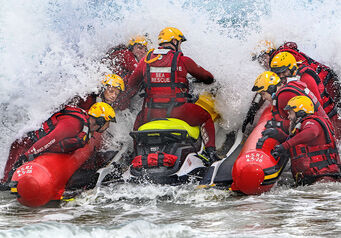
At the heart of Fish Hoek SAT’s capability is the JetRIB, NSRI’s fast inshore rescue vessel, able to launch and reach casualties within minutes. Unlike the larger ORC-class rescue boats that require a full crew and launch setup, the Fish Hoek-based team can deploy fast.
“Many of our crew live in the Fish Hoek area, and especially in peak times when there’s heavy traffic, it’ll be quicker to activate the SAT station,” says Darren. “And although it’s a rapid response to get people out of the water, it will still be backed up by a response from the main station.” The dual activation model – both stations launching simultaneously – ensures that smaller rescues are handled swiftly, while the main base remains ready to support complex or extended operations.
Powered by Community and Purpose
Fish Hoek’s satellite setup exemplifies how NSRI adapts its footprint to emerging risks without straining existing resources. Charl explains, “It’s a prepositioning of equipment and local people who can respond quicker because they are there.” He adds that the station is “a partnership and a gift from the community, the ski boat club, and the surfski club.”
The model also nurtures the next generation of NSRI coxswains. Operating a JetRIB requires a Class 4 coxswain certificate – a qualification that’s achievable in a shorter timeframe than the larger vessel licences. Darren says, “The response to the opening of the SAT station has been very good, especially with our slightly younger generation. It gives them a great opportunity to start learning to be a coxswain.”
Staying Safe Along the Coast
The new station doesn’t replace vigilance from the public; it reinforces it. Fish Hoek’s beaches remain popular with paddlers and families, and the sea can turn unforgiving in moments. Darren offers a word of advice: “Rip currents are dangerous. Make it your business to understand what a rip current looks like and how to manage yourself if you’re caught in one. Always make sure someone’s watching you or your kids when swimming.”
With its JetRIB on standby, its local volunteers ready, and its deep community roots, the Fish Hoek SAT station embodies NSRI’s ongoing evolution: lean, fast, and close to where help is needed most. “It’s all about creating a quicker rescue response, and making use of the local community to get to people in need, sooner,” Charls says.
The NSRI’s New Seasonal Range Makes Waves
Read More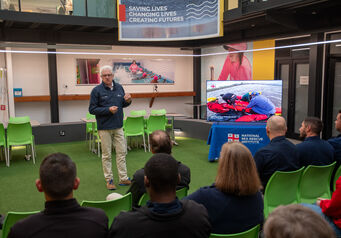
Western Cape Premier Alan Winde today visited the National Sea Rescue Institute (NSRI) Volunteer Support Centre (VSC) in Cape Town to thank volunteer crews and staff from across the province who were activated during the recent floods. ...
Send us your favourite photograph of NSRI people doing what we do, and you could win an NSRI shop voucher worth R250! ...
The NSRI has secured a significant three-year partnership with the Victor Daitz Foundation and World Relief Australia to fund a dedicated Drowning Prevention Instructor in Richards Bay, KwaZulu-Natal. ...