

In Plettenberg Bay, the sound of a siren drifting across town carries a meaning that locals understand instantly. It signals that the NSRI are responding to an emergency at sea. Cars pull over, conversations pause, and people turn their attention toward the water.
A Siren with a Unique History
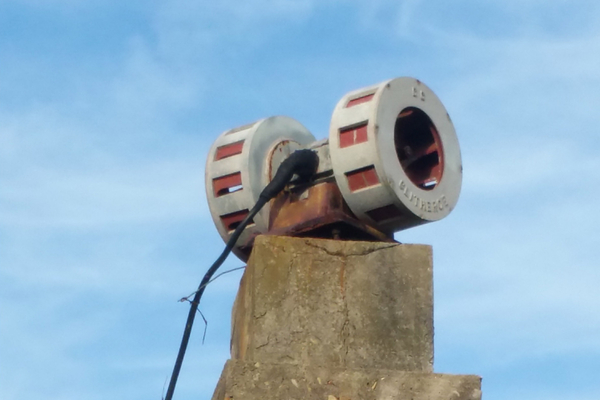
The siren itself has an unusual story. According to retired NSRI crew member Derek Frielinghaus, the 85-year-old London air raid siren mounted on the water tower at Signal Hill dates back to World War II.
“We have all heard the Sea Rescue Siren go off in earnest over the December season in Plett, but not many know the history behind it,” he wrote in a recent Facebook post.
Signal Hill is a fitting home for such a device. In the 1800s, the hill served as a lookout point where the village harbour master would hoist warning flags to alert passing sailing ships to danger in the bay. Today, that tradition of warning and response continues through the siren that sits above the town.
How the Siren Came to Plettenberg Bay
The story of how it arrived in Plett goes back to the early 1970s, when the NSRI station was still finding its footing. At the time, volunteers needed a reliable way to alert crew members when lives were in danger at sea. Various ideas were suggested, including firing flares or maroons into the sky. Eventually, someone proposed installing a siren, though at first the only ones the team was familiar with were factory models.
Help came from an unexpected source. The town’s newly appointed electrical engineer, Frank Redford, had previously worked for the City of London. He knew that hundreds of air raid sirens used during the Blitz of 1939 were still in storage. Frank wrote to a friend in the London municipality, and before long, the city agreed to donate one of the historic sirens to the small coastal town. Shipping company Safmarine helped transport it to Cape Town, from where it was eventually delivered to Plett.
Early Years of NSRI in Plett
For Derek, the siren is deeply tied to his own memories of the early days of sea rescue in Plett. He joined the NSRI in 1970 at the age of 22 after being approached by Commander Cobbald in his supermarket.
“There were about 8 of us who started as crew. A few had experience driving boats, but most were young, fairly fit, and could swim,” he recalled.
Those early years were a time of learning and sometimes hard lessons. Equipment was basic, and the team relied heavily on teamwork and discipline. Derek eventually became chief controller and later served as station commander before stepping down in 1989.
The Siren’s Emotional and Practical Role
Despite technological advances transforming rescue operations, the Signal Hill siren remains an important part of the station’s identity.
“The siren is a great advertisement for NSRI and many folks, when they hear it, stop and say a prayer to the crew,” Derek says. “It is known that the siren once went off on a Sunday during a church service. The priest stopped the service and offered a prayer for the safety of the crew and whoever they were trying to rescue.”
The Siren Today
Today, the siren still plays a role alongside modern communication tools. Station 14, Plett Station Commander Jaco Kruger explains that the siren is tested every Friday at noon with a short burst to ensure it is functioning properly.
When a serious emergency occurs - such as a drowning in progress or a boat capsizing - the siren is activated to alert both volunteers and the community.
“It helps people give us way so we can respond quicker and pull the cars off the side of the road,” Jaco says. “It cuts our response time by a lot. So that works super well.”
Modern systems like mobile phones and WhatsApp groups now alert crew members directly, but the siren remains a powerful backup and a highly visible signal to the town.
“If for any reason there’s no communication, I know I can set the siren off, and the crew will come,” Jaco says.
More than fifty years after it first sounded above the town, the Signal Hill siren still does what it was meant to do - call volunteers to action and remind the community that when it sounds, someone out there needs help.

Maritime Extrication Training in the Trees
Read More
Western Cape Premier Alan Winde today visited the National Sea Rescue Institute (NSRI) Volunteer Support Centre (VSC) in Cape Town to thank volunteer crews and staff from across the province who were activated during the recent floods. ...

Send us your favourite photograph of NSRI people doing what we do, and you could win an NSRI shop voucher worth R250! ...

The NSRI has secured a significant three-year partnership with the Victor Daitz Foundation and World Relief Australia to fund a dedicated Drowning Prevention Instructor in Richards Bay, KwaZulu-Natal. ...