

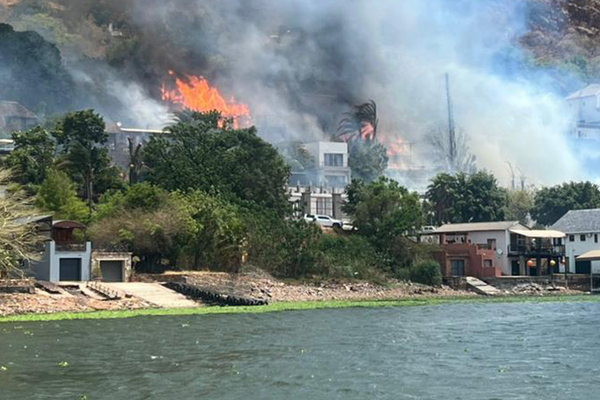
The National Sea Rescue Institute exists to save lives at sea and on inland waters. Fire response is not part of its core mandate, and any involvement in wildfire incidents must take place within South Africa’s legal and emergency-response framework.
Retired Koeberg fireman and former Melkbosstrand Station Commander Rhine Barnes explains that the Fire Brigade Services Act makes provision for formally appointed firefighters and volunteers who operate under the authority of a Chief Fire Officer.
For this reason, when NSRI volunteers are present at fire incidents, their involvement is carefully managed and guided by the fire service in charge.
Rhine explains that the law provides clear boundaries for members of the public, including NSRI volunteers. A member of the public may not:
Join an active firefighting operation
Enter the danger zone of the fire ground
Take instructions directly as a firefighter
Exercise any powers granted to fire brigade members
This legal boundary is critical. It protects volunteers and ensures that fire scenes remain structured, controlled and safe.
How NSRI Volunteers Step Forward
Within these limits, NSRI volunteers are often present when wildfires threaten their towns and communities. Their motivation is rooted in the organisation’s culture of service.
“The very nature of the NSRI is to save lives and to serve those who need help. This is the driving factor that prompts a crewmember to get involved and to assist wherever possible when the community needs it most,” Rhine says.
That instinct does not disappear when an emergency happens on land. When fire services are stretched, and communities are under threat, NSRI crews are often nearby, trained in teamwork, risk awareness and incident discipline.
Their role is not to replace firefighters, but to support them when requested and authorised.
A Story from the Fire Line
Rhine recalls a wildfire that once moved rapidly toward Duynefontein in Melkbosstrand. At the time, he was the Chief Fire Officer and had access to a large fire engine, but not enough firefighters who could leave their posts.
“I asked for volunteers from Station 18, and in no time, had a truck full of willing hands who would use the hoses and equipment available to put out the fire. The crew were almost as excited to be driving around in a fire engine as they were going to sea in a rescue vessel.”
The story is not about Sea Rescue becoming firefighters. It is about trained volunteers responding when asked, under proper authority, in a moment when extra hands made a difference.
Limits, Safety and Discipline
Rhine is clear that assistance must be controlled and lawful. He warns that fire officers should not allow informal participation because of the risks involved. For NSRI stations that are regularly asked to assist, formal arrangements and training are essential.
“If a rescue station is regularly called upon to assist with fighting fires, then I suggest that the station first get the ok from Brett Ayres as the Operations Director before approaching the local authority Chief Fire Officer. There may be a need to set up a formal agreement and basic training requirement.”
Even clothing matters when assisting. “If a crewmember is not properly dressed, ie. Long pants and long sleeve shirt of natural fibres, closed shoes and a cap, they should not be involved in fighting the fire.”
And above all, crews must report to the incident commander and wait for instructions, not arrive independently or act on their own initiative.
Strengthening Community Trust
Supporting fire services, within legal and safety limits, reinforces the NSRI’s role as a trusted community organisation.
“From a publicity perspective, to portray the image of the NSRI as an organisation that will support and take care of their community in times of need, it is good for our crew to offer and render assistance.”
Rhine adds that fire services value working with disciplined volunteers. “A fire service would much rather deploy the members of a structured and disciplined organisation such as the NSRI than a member of the public.”
Wildfires test more than fire crews. They test communities, emergency systems and volunteers. The NSRI’s involvement is not about fighting flames. It is about standing with communities under threat and offering lawful, safe and responsible help. Not as firefighters. But as Sea Rescue volunteers who understand what it means to respond when lives and property are at risk.
A New Era for Sea Rescue at Mykonos
Read More
Western Cape Premier Alan Winde today visited the National Sea Rescue Institute (NSRI) Volunteer Support Centre (VSC) in Cape Town to thank volunteer crews and staff from across the province who were activated during the recent floods. ...
Send us your favourite photograph of NSRI people doing what we do, and you could win an NSRI shop voucher worth R250! ...

The NSRI has secured a significant three-year partnership with the Victor Daitz Foundation and World Relief Australia to fund a dedicated Drowning Prevention Instructor in Richards Bay, KwaZulu-Natal. ...