

It was a year of courage and impact for the National Sea Rescue Institute (NSRI). In 2025, thousands of lives were touched, not only in moments of crisis, but through education, training, and the steady presence of volunteers along South Africa’s waterways.
Head of Operations, Charl Maritz, reflects: “It is a fantastic thing to see and be part of. It is a great shout-out of thanks and appreciation not only to the operational volunteers at stations, but also volunteers in the space of rescue buoy management, beach safety camera operation and community programmes.”
A Year in Numbers
During 2025, NSRI responded to 1,069 active operational calls, assisting 1,548 people, 300 vessels and 70 animals. Around 20% of these incidents were concentrated in the summer season over December, a period that places enormous pressure on crews, lifeguards and support teams.
Across the country, 1,431 active operational personnel were rostered to stations, navigating the ongoing challenge of balancing personal lives with voluntary service, yet keeping bases operational and response-ready throughout the year.
Rescue Operations and Medevacs
Operationally, NSRI crews faced everything from small crafts in distress close inshore to complex medical evacuations far offshore, often at night and in challenging sea conditions.
In recent years, NSRI has seen a rise in medical evacuations (medevacs) of injured or ill crew members aboard large vessels, such as container ships and tankers.
Positioned along key global shipping routes, South Africa’s ports – including Richards Bay, Durban, East London, Gqeberha, Mossel Bay, Cape Town and Saldanha – are frequently called upon for urgent rescue medevac operations, demanding highly trained crews capable of climbing ships’ ladders, working high above the waterline and stabilising patients in confined spaces before transfer to the rescue craft.
To meet this need, the NSRI has developed a structured MEX training programme to prepare for these high-risk rescues, with progressive levels of training that now support missions such as the evacuation of a seriously injured crewman from an oil tanker and urgent callouts to cruise liners and fishing vessels.
Strengthening Operations and Leadership
In 2025, a full operational restructure of the Volunteer Support Centre (VSC) was completed under Chief Operating Officer Brett Ayres. The restructure formalised clear support pillars in operations, training, lifeguarding, fleet and facilities, and community programmes to strengthen stations.
The Emergency Operations Centre, led by Rizia Kahn, and NSRI’s communication structures, led by Craig Lambinon and Andrew Ingram, continued to provide strong real-time support to stations. They coordinated callouts and shared critical information between coastal and inland stations.
It was also a Station Commander election year, ushering in a new term of leadership from 2025 to 2028. Eleven new station commanders stepped into these roles, supported by regional station commander training focused on administration, station management, and peer learning across various provinces.
Training
The NSRI training calendar in 2025 remained demanding and deliberate, combining courses at the VSC with on-site and at-station training.
External courses continued to qualify new coxswains, maritime extrication technicians and swift-water operators. National initiatives such as the coast-to-coast coxswain development programme brought candidates together from multiple stations, including new volunteers from emerging bases like Mdumbi.
Fleet, Facilities and New Stations
The fleet and facilities teams carried a significant share of the load in 2025, keeping vessels, vehicles and bases operational, while driving major capital projects that are revitalising NSRI’s fleet and infrastructure.
Key among these are the new base builds and Offshore Rescue Craft (ORC) deliveries for Station 4 Mykonos and Station 8 Hout Bay, both due for completion in 2026, with ORC number 7 destined for Mykonos and number 8 for Hout Bay. The Rodman currently at Mykonos is set to be relocated to Station 15 Mossel Bay as the final move in the Class 1 fleet upgrade project.
Two stations reached important milestones on the Wild Coast and Garden Route. Station 49 Mdumbi transitioned from an auxiliary into a fully-fledged station with a JetRIB and rescue vehicle capability, with plans for a permanent base to follow. Station 46 Storms River moved from satellite status to operating as an independent station in a region known for river and coastal adventure tourism.
Lifeguards and Safer Beaches
On beaches and at pools, NSRI lifeguards once again formed a critical preventative frontline over the 2025 season. Charl notes that NSRI provided contracted lifeguarding services in 11 municipal areas, covering 53 beaches and pools, deploying around 200 lifeguards during the peak holiday period.
These lifeguards not only responded to emergencies but also played a daily role in prevention: educating beachgoers, identifying hazards and working alongside municipalities and local partners to keep public spaces safe.
Community Programmes
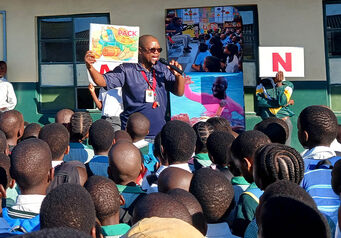
The department formerly known as Drowning Prevention has evolved into the Community Programmes portfolio, under the leadership of Mthe Kweyama. In 2025, this team reached close to one million children with water safety education through school visits and community gatherings, while Survival Swimming Instructors delivered more than 25,000 survival swimming lessons, equipping those most at risk with practical skills.
NSRI Operations Manager, Bruce Sandmann, highlighted a key 2025 goal of expanding NSRI’s corporate and volunteer footprint through structured programmes where companies commit staff time to being trained to deliver classroom-based water safety education in schools. This model is designed to meet the growing demand for instructors and broaden the organisation’s presence in communities that do not have traditional rescue stations.
Looking Ahead with Gratitude
Charl is clear that none of this would be possible without volunteers and supporters: “Despite the challenges, our people are serving with great dedication and achieving great results in the numbers that reflect the 2025 year.”
As NSRI looks beyond 2025, it remains focused on growing its impact in areas where it has not traditionally been active. It is building pockets of trained responders and deepening partnerships that make water spaces safer for everyone, from coastal holidaymakers to children playing near rivers and dams.
In every statistic is a story, and in every story are volunteers, donors, partners and communities who choose to stand together for saving lives on South Africa’s waters.
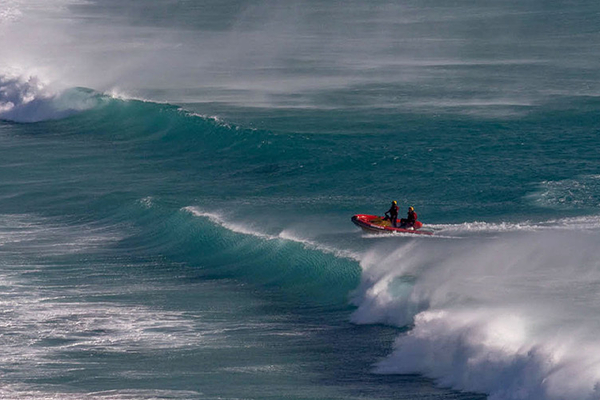
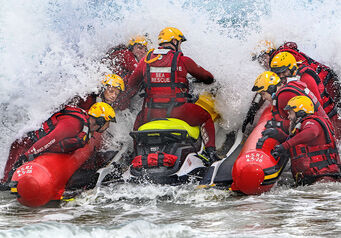
Photograph: The Kommetjie JetRIB, Sea Ranger 32, using a rip current to get in at Noordhoek. Picture Simon McDonnell.
Watch Charl speak about the 2025/2026 festive season.
Strengthening NSRI Rescue Operations with INEOS Automotive
Read More
Western Cape Premier Alan Winde today visited the National Sea Rescue Institute (NSRI) Volunteer Support Centre (VSC) in Cape Town to thank volunteer crews and staff from across the province who were activated during the recent floods. ...
Send us your favourite photograph of NSRI people doing what we do, and you could win an NSRI shop voucher worth R250! ...
The NSRI has secured a significant three-year partnership with the Victor Daitz Foundation and World Relief Australia to fund a dedicated Drowning Prevention Instructor in Richards Bay, KwaZulu-Natal. ...